
Do you remember how we always googled everything not so long ago? Any question we ever wanted answered, from finding the origin or meaning of an obscure word to that article you once read, we went to Google. It was our first choice and almost impossible to imagine a life on the internet without the search giant.
Now?
Not so much. At least, I find myself spending more time with ChatGPT for answers than Google. In fact, if Google search disappeared tomorrow, life would be inconvenient for a wee bit, but I would survive just fine. I wouldn’t miss it any more than I miss dial-up internet.
In other words, no matter how invincible a company might seem, it doesn’t matter how supreme or beloved a product is, it won’t remain a cash cow forever. And this leads me to the crux of the matter: what is the next big thing you are working on? Or even better, do you have a moonshot portfolio?
Wake Up
Getting back to Google, the undisputed king of search with over 90% market share, now faces unprecedented pressure as ChatGPT has grown from zero to capturing between 2-9% of search queries in just 24 months. For a company that processes 14 billion searches daily, even a 2% shift represents billions in potential revenue at risk.
It reminded me of a time when Internet Explorer beat Netscape and reigned supreme at one time only to lose it all to Google Chrome. Internet Explorer seemed untouchable but then it crumbled — and how.
We’re witnessing the fastest market disruption in modern business history. This isn’t just limited to technology or any one industry in particular, but across the spectrum of all services and manufacturing industries. If you don’t have an aggressive growth strategy powered by innovation and passion, your organization will probably cease to exist when the new industrial infrastructure (hastened, if not triggered by the advent of AI) matures.
Naturally, the question arises, what do I mean by “aggressive growth strategy”? I am not referring to just selling more of what you have in existing or new markets, but staying ahead of the curve. And you can’t be ahead of the competition, if you are not betting your chips on the next breakout idea, or what I usually refer to as moonshots.
Start With the Uncomfortable Question
To break free of the illusion of lasting success and the shackle of complacency, start with this question: If your primary revenue stream disappeared tomorrow, would your company survive? As dramatic as it may seem, if you hesitated to say a clear yes, you’re already behind.
When I was building my enterprise, one word that everyone in my sales team held sacred was pipeline (followed by an actual customer order, of course). It was only natural that some prospects would take longer than expected to sign on the dotted line and that some would fizzle out completely. Or that some order would end up smaller than originally envisioned etc. All of that was bearable as long as we had enough active conversations going on with other potential customers.
The same principle applies to your verticals or product ideas. If most or all of your revenue comes from just one thing, we have a real problem on our hands that deserves your attention.
So, what would happen if your biggest competitive advantage disappeared in 18 months? What would you build to replace it?
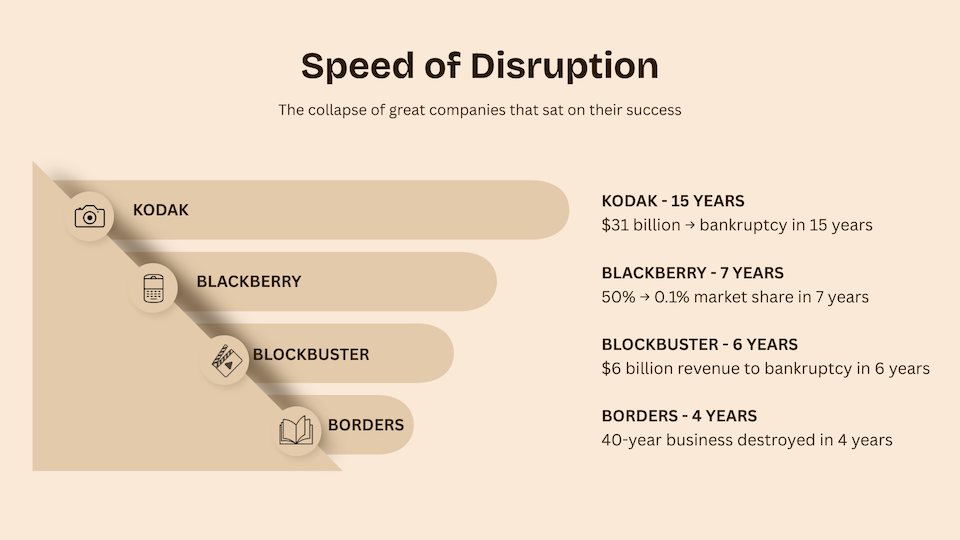
Companies that cushion themselves in a cocoon and refuse to budge, eventually perish. The reason is simple: whether we like it or not, no industry is immune to disruption. See the chart below of companies that went belly up because they were too successful for their own good.
Build Your Moonshot Portfolio
Whether it’s innovation-funnel (many raw ideas enter, fewer survive as they’re filtered, tested, and validated) or innovation-pipeline (validated ideas move to concept → prototype → testing → launch), you cannot afford not to have it a part of your active strategy.
Imagine Meta trying to compete in today’s market with just Facebook. What if Mark Zuckerberg had not paid $1 billion for Instagram in 2012 (which now generates over $50 billion annually) or $19 billion for WhatsApp (the most dominant global messaging platform)?
What if Amazon was still just an online bookstore? Jeff Bezos would be running a quaint little shop with a bell on the counter instead of getting married in Venice. What if it was still not a marketplace, or had no Kindle, AWS, or Alexa? Amazon marketplace contributes to 60% of its revenues. AWS represents 70% of Amazon’s operating income today.
Or, imagine if Google did not have Gmail, YouTube, Android, Maps, or Google Cloud in its portfolio. YouTube generates over $30+ billion in revenue. Google Cloud is growing 35% year-on-year and contributes over $33 billion in annual revenues. Android powers 70%+ mobile devices globally. You get the idea.
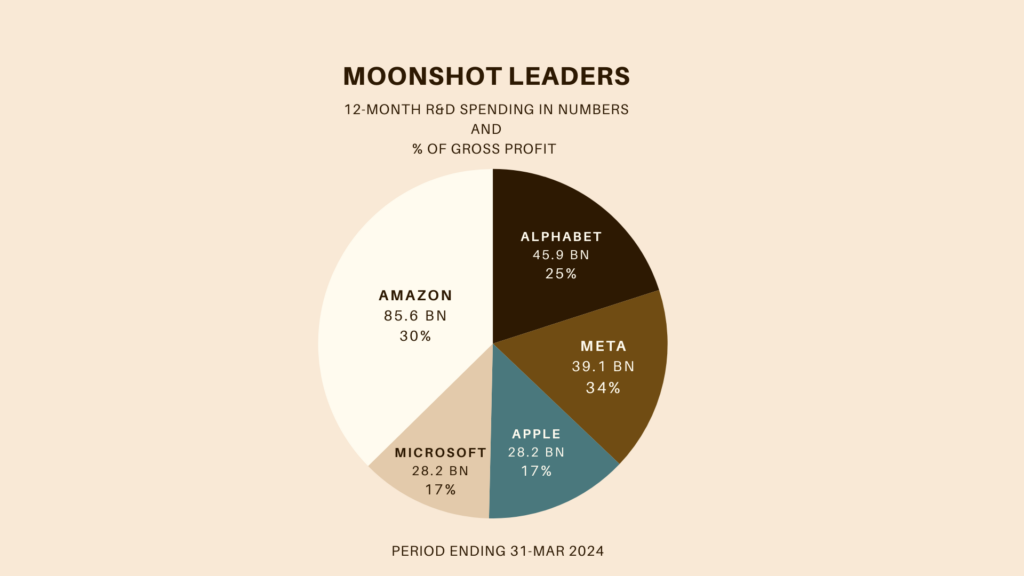
In fact, see how some of the world’s greatest companies spend heavily on research and development. This does not include the money they spend on acquisitions (something for another time).
Make It Your (And Everyone’s) Problem
Building your moonshot portfolio is not a matter of just getting luck or eternally waiting for the right opportunity to come along. It is about building a culture in your company where growth is everyone’s business, where excellence is everyone’s KPI, a culture where each individual is a part of the next breakout idea in one manner or another. To master the moonshot mindset, here are three key principles:
1. Be Optimistic but Paranoid
No matter what or how great your advantage, just remember, it’s temporary. If you are not the disruptor, you will be disrupted. It is inevitable. Every industry faces its ChatGPT moment.
Recently Mark Zuckerberg said, “If we end up misspending a couple of hundred billion dollars, I think that is going to be very unfortunate, obviously. But, what I’d say is actually I think the risk is higher on the other side… The risk, at least for a company like Meta, is probably in not being aggressive enough rather than being somewhat too aggressive.” ((Business Insider. 19-Sep-2025))
2. Speed Over Perfection
Do it fast. Do it already. As Reid Hoffman once said, “If you’re not embarrassed by the first version of your product, you’ve launched too late.” Your people will make mistakes but still encourage and reward experimentation, even when experiments fail.
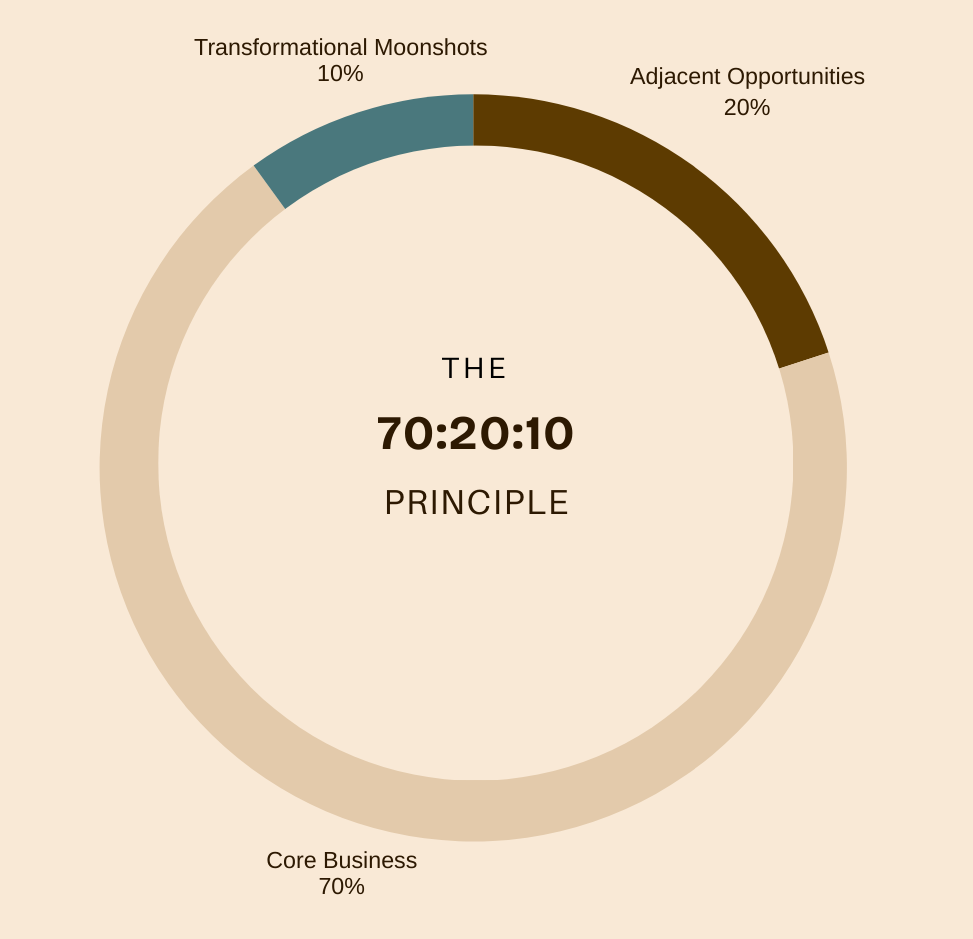
3. The 70:20:10 Principle
When it comes to building your moonshot portfolio, don’t put all your eggs in one basket. Identify three adjacent markets your capabilities where could create value. Allocate budget and talent to moonshot experiments and if you are really serious about growth, set learning goals, not just revenue targets, for new initiatives.
From my experience (and observation), I have noticed that companies that operate without a persistent sense of urgency die a slow death. Being aggressive about growth should feel like an epidemic in your company. And such growth is simply not possible without a moonshot portfolio. Remember, moonshots are not incremental bets but radical commitments.
The future is already being written. I hope you are holding the pen and scribbling your destiny. As they say, if you aim for the moon at least you will get to the stars. Well, don’t settle. Get on the moon. If you won’t, others will.
Companies that turn a blind eye to the inevitability and urgency of innovation and disruption get neither the stars nor the moon. Instead, they walk into oblivion becoming no more than a hazy footnote in the books of history.
March on,
Swami